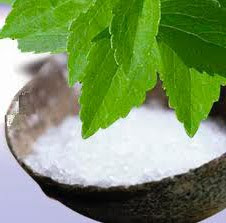
 Make sure you know the difference between the good guys and bad guys of the sweetener world. Here is a list of the good guys of sweeteners:
Good Guy #1: Stevia
"We need to be off of sugar, but we need good alternatives, and stevia is the safest sweetener there is, period," says Gates, who coauthored The Stevia Cookbook: Cooking with Nature's Calorie-Free Sweetener (Avery Trade, 2004). All types of stevia are extracted from the leaves of the stevia plant, but some forms taste better than others, says Gates. People tend to overuse powders, in which the sweetness is really concentrated, so if you've tried powders in the past and didn't like them, try liquid forms, explains Gates, who helped develop a liquid stevia sweetener product. Stevia contains zero calories, but its one downfall is that it doesn't work well for baking. Expect to see more stevia on store shelves, as Coke and Pepsi got the green light to use Truvia (a sweetener made in part from stevia) starting later this year.
Good Guy #2: Sugar alcohols
Popular sugar alcohol sweeteners include xylitol, sorbitol, and erythritol, natural sweeteners made through a fermentation process of corn or sugar cane. They contain fewer calories than sweeteners like pure sugar and honey, but more than stevia. They also leave a cooling sensation in the mouth, and have been found to prevent cavities, explains Dr. Gerbstadt. Just don't overdo it—too much can cause GI distress.
Good Guy #3: Organic, raw local honey
While honey does boast higher fructose levels, it also contains a bounty of cancer-defending antioxidants, and local honey has been said to help alleviate allergy symptoms. Don't limit raw honey's use to your tea, either. Use it to speed healing on burns, and as a natural antiseptic on cuts and scrapes. Honey also has a low glycemic index, so adding it to your tea or yogurt won't lead to energy-busting blood sugar drops later in the day.
Good Guy #4: Blackstrap molasses
Although heavy on the calorie content, blackstrap is rich in iron, potassium, and calcium, making it a healthier choice than nutritionally defunct artificial sweeteners or even regular refined sugar, despite the fact that blackstrap and refined sugar both come from sugar cane. (Dr. Gerbstadt says calorie-containing sweeteners are not recommended for people with diabetes.) We like the organic, Fair Trade Certified version of blackstrap molasses from Wholesome Sweeteners.
Tuesday, September 27, 2011
The 4 Best Sweeteners to Have in Your Kitchen

Monday, June 21, 2010
'The Cove' to screen in Japan despite protests
 "The Cove," an Oscar-winning film about a dolphin-hunting village in Japan, will be shown in the country from next month, despite pressure from nationalist groups that caused several theaters to cancel screenings.
The domestic distributor, Unplugged, said Monday that six theaters around the country will start showing the movie July 3, with 16 more to show it later.
Initial screenings of the film at three other theaters were canceled early this month after protests by nationalist groups, who say the film is anti-Japanese, distorts the truth, and has deep connections with a militant anti-whaling organization.
The issue erupted into a broad debate on freedom of speech after those theaters pulled out to avoid disruptive protests on their doorsteps. National newspapers widely condemned the cancellations in editorials, and prominent film makers, journalists and lawyers publicly urged theaters not to back down.
Tuesday, May 25, 2010
Brown Egg and White Egg
 We often hear that white egg is better than brown egg but actually the only difference between a brown and white egg is the color of the shell. Despite what you may have heard, one isn't healthier, more "natural," or more eco-friendly than the other. And there aren't any differences in nutritional quality, flavor, or cooking characteristics.
The color of the shell is merely a reflection of the breed of the hen. In general, but not always, hens with white feathers and earlobes lay white eggs and those with dark feathers and red earlobes lay brown eggs.
It may be surprising to learn that not all eggs are brown or white. For example, some rare chicken breeds, such as the Araucana and Ameraucana, lay blue and blue-green eggs.
Tuesday, July 21, 2009
Red flags that indicate a food/weight obsession
 There’s often a fine line between eating healthfully to slim down and becoming fixated with food. Here are some red flags that could indicate a food/weight obsession.
1. There's zero variety in your diet
You’ve had Rice Krispies with fat-free milk for breakfast every day for 10 years. For lunch, it’s always salad with the same fat-free dressing. And for dinner, what’s wrong with grilled chicken and steamed broccoli Monday through Thursday?
Fact is, someone who eats like this takes no pleasure in food. The satisfaction comes not from the experience but from knowing they’ve met requirements on a nutrition label. Another danger: missing important nutrients. Different grains, dairy, meats, nuts, beans, vegetables, and fruit means you get a variety of essential vitamins, minerals, and antioxidants every day.
2. You count every last calorie.
It’s one thing to watch your intake while you’re trying to lose weight. But over time, people can gauge how much to eat to maintain weight loss without poring over every label. If you’ve cut calories dangerously low (less than 1,200 a day for most women) and your life revolves around your food "rules," then you’ve taken things too far.
Calorie hawks also feel guilty when they don’t follow their plan—like the rest of the day is ruined. Severe restriction can lead to anorexia or thwart weight loss efforts by slowing metabolism—not to mention that you’ll feel hungry, exhausted, foggy, and grumpy if you don’t consume enough nutrients.
3. You view foods as "good" or "bad."
Bread is "bad"—so having a bagel for breakfast is a rare treat. Baby carrots are "good," so there’s zero guilt about eating them as a snack. If you compartmentalize food choices like this, you’re setting yourself up for a tricky tango later. Once you have a “bad” label on something, under certain conditions you’ll crave it more, lose all control, and binge. Research shows that people have only so much willpower; if you try to limit too many things at once, you’ll end up caving more quickly. Of course, certain foods are inherently healthier than others—so this doesn’t mean you can eat fast food whenever you want. But that’s where portion control comes in. Train yourself to have just one Munchkin and then concentrate on something other than eating.
4. You're 100% organic, 100% of the time.
We know organic, unprocessed, whole foods are healthiest, but some people take the mantra to an extreme. This could be you if you refuse to shop for groceries or eat at places that don’t meet your healthy standards, you decode every ingredient label and deem all foods with "unnatural" ingredients off-limits, or you perceive processed products as dangerous to your health. Loosen your standards a bit when you’re out and about. One nonorganic meal won’t kill you, or even hurt you, and you can feel confident that your health is benefiting from all the other healthy food you eat 90% of the time.
Friday, June 12, 2009
Crow Meat can Boosts Sexual Potency?

Despite their intelligence and function as scavengers, crows are rarely popular birds.
The large black birds with a noisy squawk have traditionally held the role of evil-doer or thief in fable and fairy-tales.
In Lithuania, crow has been part of a traditional diet throughout the centuriesmostly eaten during times of hardship.
The meal of crow remained widespread in Lithuania into the 20th Century but almost died out during Soviet occupation. Now it is making a comeback.
SOUNDBITE (Lithuanian) Andrius Gudzinskas, Hunter: "We are hunting young crows because we need them for our feast, which is a century-old tradition. I support this tradition and will keep doing it (shooting crows). The birds are not bad - they do good but they also do harm. Their number can only be regulated by hunting."
Hunts for the black colored birds, which has several species nearly world-wide, last several days, and involve driving hundreds of kilometers in search of crow flocks.
Back home, the birds are plucked and then the crow meat is prepared in cooking oil at a high temperature and served with vegetables.
SOUNDBITE (Lithuanian) Vanda Mikalauskiene, Cook: "We boil it for about an hour because it's game meat and it's tough. Usually a chicken is boiled for 15-20 minutes but this is a wild bird."
The hunters claim the younger birds are better. Here they are considered delicacies, said by some to taste like quail.
SOUNDBITE (Lithuanian) Dalia Keriene, Kalnaberze Resident: "This is a great dish, crow meat is very tasty and good for men because it increases sexual potency. Try it and you'll see."
With its reputation as a scavenger, which includes dining from piles of garbage, some fear disease from eating crow. But a local medic explains that after being cooked at the right temperature the crow meat is absolutely safe to eat.
SOUNDBITE (Lithuanian) Kristina Mikolaitiene, Medic: "Crows are cooked in boiling oil with a temperature of 190 degrees Celsius so that all bacteria die and there is no danger for health."
In the village of Kalnaberze, residents gathered for a recent feast to devour the crow meat.
SOUNDBITE (Lithuanian) Jorune Liutkiene, Kalnaberze Resident: "I've been taking part in this feast for three years. I like it. When tried it for the first time I was a little bit scared but then I understood that it's tasty."
While eating crow is an English idiom that might refer to admission of a humiliating mistake, in Lithuania, it could be part of a re-emerging tradition.
© 2009 National Geographic (AP)


