 A flaw on a number of HTC smartphones available in Australia means a hacker can find out where you are, who you have called and sent text messages to and disable your phone remotely, security experts say.
To be exploited the flaw requires a rogue app to be granted access to the internet, which most apps require. Once granted access the app can then gain access to data that has been shown to be exposed.
Fairfax Media reported in May on a 400 per cent increase in malware since the middle of last year on Google Android, the mobile operating system installed on the HTC smartphones affected. Google regularly sweeps clean its Marketplace of malicious apps but doesn't always find the bad ones.
An Australian security expert has labelled the reported security flaw in HTC Android smartphones as "far more serious" than Apple's iPhone location tracking scandal and Facebook's tracking of users across the web.
Data exposed includes not only the phone's last known network and GPS locations and a limited previous history of locations (as was seen in the Apple iPhone location tracking scandal) but SMS and phone number data too, as well as a phone's list of user accounts, including email addresses and sync status for each.
Sunday, October 9, 2011
Android Phone Hacking Scare Alert

Tuesday, October 4, 2011
Kindle Versus iPad
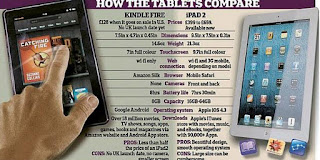 Kindle has become one hot brand in Amazon! Amazon has unveiled a touchscreen tablet com-puter in an attempt to pull the rug from beneath Apple and its iPad. The Kindle Fire, which has many similar functions, will be sold in the U.S. for $199 (£128), less than half the price of the cheapest iPad available.
The low cost stunned technology industry watchers, who suggested that Apple and other tablet manufacturers would have to cut their prices. Users will be able to access more than 18million movies, television programmes, songs, apps, games, books and magazines via the Amazon website.
The device has a seven-inch screen, compared with the iPad 2’s 9.7-inch display. And unlike the iPad, it will not have a camera or be able to make video calls.
Unveiling the tablet in New York, Amazon’s chief executive, Jeff Bezos, said: ‘Kindle Fire brings together all of the things we’ve been working on at Amazon for over 15 years into a single, fully-integrated service for customers.
‘These are premium products at non-premium prices. We are going to sell millions of these.’
The Kindle Fire will be available in the U.S. from November 15.
Although no date has been set for it to go on sale here, Britain will be getting the latest version of the basic Kindle, which is thinner and lighter than existing eReaders. It will cost £89 – but even this is a mark-up of almost 80 per cent compared to the U.S. There, the new version will cost $79 – about £50.
A company spokesman defended the pricing, saying that the new basic Kindle was the ‘most affordable’ ever. She added: ‘Operating costs differ by country, but as with all products on Amazon, we work hard to offer customers the lowest possible prices.’
But Professor Ajay Bhalla, a technology expert from Cass Business School in London, said: ‘Amazon has not got the pricing right. Consumers are smart and there is plenty of choice in this market.’ He doubted the Kindle Fire would pose a meaningful challenge to the iPad because of the absence of a camera.
Sunday, August 28, 2011
Jobs at Apple: Master inventor, master marketer
 Steve Jobs started Apple Computer with a high school friend in a Silicon Valley garage in 1976, was forced out a decade later, then returned to rescue the company. During his second stint, Apple grew into the most valuable technology company in the world.
Jobs invented and masterfully marketed ever-sleeker gadgets that transformed everyday technology, from the personal computer to the iPod and iPhone. Cultivating Apple's countercultural sensibility and a minimalist design ethic, he rolled out one sensational product after another, even in the face of the late-2000s recession and his own failing health.
Jobs helped change computers from a geeky hobbyist's obsession to a necessity of modern life at work and home, and in the process he upended not just personal technology but the cellphone and music industries.
Perhaps most influentially, he launched the iPod in 2001, which offered "1,000 songs in your pocket." Over the next 10 years, its white earphones and thumb-dial control seemed to become as ubiquitous as the wristwatch.
Sunday, August 29, 2010
Google Chrome 7 Gets GPU Acceleration for 2D and 3D Content
One of the big features in the upcoming Internet Explorer 9, that Microsoft has been touting for months is hardware acceleration. But it now looks like Google Chrome may be getting GPU acceleration before IE 9 lands, even if it only announced the feature yesterday.
The latest Chromium builds can now send some of the rendering directly to the GPU resulting in better performance and less CPU strain. The most interesting part is that the GPU acceleration is not restricted to 3D content, some 2D operations can take advantage of the new feature as well.
"For some time now, there’s been a lot of work going on to overhaul Chromium’s graphics system," Vangelis Kokkevis, Software Engineer at Google, announced.
"New APIs and markup like WebGL and 3D CSS transforms are a major motivation for this work, but it also lets Chromium begin to take advantage of the GPU to speed up its entire drawing model, including many common 2D operations such as compositing and image scaling," he added.
"At its core, this graphics work relies on a new process (yes, another one) called the GPU process. The GPU process accepts graphics commands from the renderer process and pushes them to OpenGL or Direct3D (via ANGLE)," he explained.
The underlying technology has now been put in place. If you run a recent Chromium build with the --enable-accelerated-compositing flag, you'll notice the GPU process running along with all of the regular ones.
This is the process that will handle all of the hardware acceleration, be it 2D or 3D, while still keeping the web pages locked away in the sandbox.
With this in place, the team has started working on using the GPU to handle some of the tasks. For now though, most of the layers of a page, including text and images, are rendered by the CPU and then sent off to the GPU.
Video layers, though, can now do color conversion and scaling on the GPU, Google says, and 3D layers, such as those with WebGL elements, are rendered entirely by the graphics unit.
The final step, which blends all of the different layers together to create the page you see on your screen, is now handled by the GPU as well. In time, the team wants to move even more of the rendering off the CPU and onto the GPU which should result in a significant performance boost.
Visit Global Poster Indonesia - Jual Poster di Indonesia.
Monday, April 5, 2010
Windows 7 Ready to exceed Vista, XP Still the Most Popular
 Performance of Microsoft Windows 7 operating system on the market so far kept rocketing. According to statistics news from Net Applications, Windows 7 now has scooped 10 per cent share of the operating system market.
The achievement was made more quickly than its predecessor, Windows Vista which took 16 months to do the same.
Overall, the Windows operating system in various versions are still very dominant, driven 91.6 percent market share.
As quoted from Afterdawn, Windows XP still remains the most popular Microsoft operating systems because it has a 64.5 percent market share, while Windows Vista portion is 16 percent.
Vista's performance continues to deteriorate. Vista's market share declined for 5 consecutive months and is predicted to only be have less than 10 percent by the end of this year 2010. Windows 7 is expected would win Vista market share at the end of next May.
Monday, April 27, 2009
Microsoft Online Services Go Global
Microsoft Online Services are now live at a global scale. The move comes simultaneously with Microsoft wrapping up the upgrade to the Microsoft Online Customer Portal (MOCP). Technical product manager for Microsoft Online Services, Paul Englis indicated that with the latest refresh MOCP was up to version 9.1. The worldwide availability of the Microsoft Online Services means that the Redmond company has
essentially opened up the Business Productivity Online Suite and the Business Productivity Online Deskless Worker Suite on no less than 19 markets.
“We’re experiencing a significant amount of partner momentum around Microsoft Online Services and the Business Productivity Online Suite,” explained Ron Markezich, corporate vice president of Microsoft Online. “Based on the increasing demand and enthusiasm we’re seeing, it’s clear that partners are recognizing the opportunity, and that this is the right time to embrace Microsoft’s software-plus-services approach.”
In addition to giving the green light to global sales of Exchange Online, SharePoint Online, Office Communications Online and Office Live Meeting, as part of Microsoft Online Services, the Redmond company is also cutting the costs associated with the services. According to Microsoft, customers purchasing the Business Productivity Online Suite no later than the end of June 2009 will benefit from a 25% discount. At this point in time Microsoft Online Services are enjoying support from no less than 4,000 company partners around the world.
“The upgrade of the Microsoft Online Customer Portal (MOCP) is complete, and with that upgrade the 9.1 release is fully deployed. MOCP is the commerce engine that power Microsoft Online Services. The MOCP 9.1 release enables the Business Productivity Online Suite to be trialed and purchased in 19 countries around the world. Commercial availability was announced on March 3; the 9.1 release makes realizes the capabilities noted in the March 3 announcement,” Englis stated.
Sunday, December 7, 2008
Optical Technique Tells Fake CDs from the Originals
 Pirated CDs and DVDs are a major dent in profits for large companies, considering the fact that some countries use stolen software on 70 to 80 percent of its market. This means that no revenues enter the pockets of the manufacturer, while its products are widely used. Now, scientists at the University of Granada (UG) came up with an ingenious way of detecting which CDs were fake, and which were genuine.
Most print runs record data on optical storage devices via a process called “printing,” which decreases per unit costs if the number of CDs or DVDs is very large. These runs are usually employed by artists or movie studios to release their productions, in large numbers, for international distribution and sales. This process leaves an unmistakable signature on the face of the disc itself, one that cannot be counterfeited, if software pirates do not own industrial-scale machines.
Most duplicators use CD/DVD-ROMs to multiply the software they've stolen or cracked. These devices do not “print” on the disc, but rather burn holes of different size on its surface. Identifying the type of holes left behind by these writers is very easy, and their signatures thoroughly differ from those left behind by large-scale printing.
Scientists from the Department of Optics at UG developed a fast, economic, and effective technique of identifying the type of inscription with each disc made, which helped them detect if the CD or DVD was genuine or counterfeited. The device analyzes the light reflection given off by the discs, and runs it through its decoding software. Light diffraction, specific to every disk, provides investigators with the information they need, regarding its origin.
Thursday, November 20, 2008
Windows 7 Will Consume Less Disk Space than Vista
 Microsoft promises to optimize the amount of disk space that Windows 7 will consume in comparison to Windows Vista. Essentially, the Redmond company is laboring to decrease the installation footprint of the operating system with the next iteration of the Windows client. While the software giant failed to indicate just how much occupied disk space it was going to shave off in Windows 7, it did inform that it was looking to have Windows Vista beat in this aspect.
"As we develop Windows 7 it’s likely that the system footprint will be smaller than Windows Vista with the engineering efforts across the team which should allow for greater flexibility in system designs by PC manufacturers. We will do so with more attention to defaults, more control available to OEMs, end-users and IT pros, and will do so without compromising the reliability and robustness of Windows overall," revealed Michael Beck, a program manager in the core OS deployment feature team.
According to Steven Sinofsky, senior vice president, Windows and Windows Live Engineering Group, the total amount of physical disk space used by Windows 7 needs to go down in order for the platform to be accommodated on SSDs. The introduction of solid-state storage into mainstream drastically limits the space available to the end user and ultimately to Windows itself. Microsoft aims to have machines with 16GB SSDs ship with Windows 7, and, given the current footprint of the operating system, it will be quite a challenge.
At this point in time, a clean installation of Windows 7 pre-Beta Build 6801 Milestone 3 takes over 6 GB of disk space. Vista manages to take hostage a similar portion of the hard disk, and in this context Microsoft has quite a lot of work to do to reduce the space occupied by Windows 7.
"Windows disk space consumption has trended larger over time. While not desirable, the degree to which it’s been allowed is due in large part to ever-increasing hard drive capacity, combined with a customer need and engineering focus that focused heavily on recoverability, data protection, increasing breadth of device support, and demand for innovative new features. However, the proliferation of Solid State Drives (SSDs) has challenged this trend, and is pushing us to consider disk footprint in a much more thoughtful way and take that into account for Windows 7," Beck added.
Friday, July 18, 2008
Add Laptop Location Tracking Security
 A new open source project allows computer users to add surreptitious location tracking to their systems. Windows, Mac and Linux versions are available.
Adeona, from researchers at the University of Washington and the University of California, San Diego, anonymously sends data to servers on a free storage system called OpenDHT. The data, which is encrypted, includes IP addresses, information about neighboring routers, and so forth. If your notebook ever gets stolen you can log into the system from another computer, access the data and notify authorities with it. Working with ISPs they should be able to locate it. The Mac version also uses a freeware program called isightcapture to take a picture of whoever is using the system.
Commercial versions of such products, such as CompuTrace's LoJack for Laptops, have been available for a long time. Typically they also offer a remote wiping function, which would seem to be a major advantage, at least for businesses.
It's not clear whether the location tracking information in the commercial products is any different from this free version. The ultimate version would use GPS hardware, but this is not typically included in notebook computers. Perhaps it should be (Yahoo! News)
Thursday, June 19, 2008
Firefox 3.0 - Over 8.3 Million Downloads on Day One
 While Microsoft was busy baking congratulatory IE cakes and cooking Internet Explorer 8 Beta 2 due in August, Firefox 3.0 went over the 8.3 million downloads milestone worldwide on just the first day of
availability. According to Chief Executive Officer John Lilly, Mozilla has served over 83 Terabytes of Firefox 3.0 in the first 24 hours since the release. Asa Dotzler, Mozilla's community coordinator, indicated that predictions ranged around 5 to 7 million downloads, especially with the server problems encountered by Mozilla when Firefox 3.0 went live. In this context, the 8.3 million is a figure which managed to surpass Mozilla's wildest expectations (at the time of this article, Firefox 3.0 downloads are over the 10.8 million mark).
"It’s been a very busy 24 hours for Mozilla folks around the world - as our 24 hour initial period draws to a close, I wanted to put a few things into perspective. A little more than 8.3 million downloads (this isn’t our official Guinness number - that will be a little lower as we weed out over counts over the next few weeks)," Lilly stated.
Citing data from Internet metrics company Net Applications, Lilly indicated that the market share of Firefox 3.0 exploded to 4% by the end of launch day. Users in 16 countries around the world account for volumes of Firefox 3.0 downloads in excess of 100,000 items, with the latest version of the open source browser being grabbed by users in no less than 200 markets worldwide. To put it simply, the numbers behind Firefox 3.0 Final Download Day, as well as the initial success are breathtaking.
"And if you’re interested in what our network has been doing over that time period: 83 terabytes served in total; at the peak, we were serving 17,000 downloads a minute (283 per second!), and saw sustained download rates in excess of 4,000/minute; our peak mirror throughput during the period was 20 gigabits/sec (a huge thanks goes to everyone who helped to create our unbelievably great mirror network)," Lilly added.
Thursday, June 12, 2008
Free M4a to MP3 Converter 5.9

Convert AAC to MP3 and M4a to MP3
Do you need to convert AAC to MP3? M4a to MP3? MP4 audio to MP3? Your favorite player doesn't support M4a audio? Then take a look at the new tool from ManiacTools, Free M4a to MP3 Converter.
The program supports a number of input formats, like the above mentioned AAC, M4a, MP4 audio, M4b (audiobooks), and some other MPEG-4 based audio formats. You can convert those types of audio files to MP3 or uncompressed WAV. The latter can be used as an intermediate format for further converting (with tools like AudioConverter Studio).
Free M4a to MP3 Converter combines professional quality with high speed and user-friendly interface. You can simply drag and drop your M4a or AAC files from Windows Explorer and then hit "Convert" (or F5 on your keyboard). On the other hand, it is also possible to fine tune quality parameters for output files. The program supports full range of MP3 settings: bit rates up to 320 Kbit/s and sample rates up to 48 KHz. This way, you can get high quality audio files along with the portability of MP3 format (which is supported now by virtually every player, hardware or software).
The program has also a built-in audio player, which allows you to listen to your AAC and M4a files even without converting them.
And last, but not least: our converter is distributed as freeware. No need to register and to enter codes. Just download and start converting your AAC and M4a files to MP3.
Main features of Free M4a to MP3 Converter:
- AAC to MP3 converter.
- Convert M4a to MP3.
- Audio books M4b to MP3 converter.
- MP4 audio converter.
- 3GP audio converter.
- AAC, M4a, M4b player.
- MP3 quality settings up to 320 Kbit/s, 48 KHz.
- Drag&Drop.
- Batch processing of multiple M4a, AAC, M4b, MP4 etc. files.
- User-friendly multilingual interface.
- Meta information (ID3 tags) is copied from source files. Converted files contain all necessary data: title, artist, album (if the data was present in the source files).
- AAC to WAV converter.
- M4a to WAV converter.
If you can't wait using Free M4a to MP3 Converter, just proceed to the "Quick Start" section.
Note: If you can't convert some files, this may be because of copy-protection. For example, M4P is a copy-protected format. If your files are copy-protected, you may want to take a look at this page.
Monday, June 2, 2008
Free Acrobat Online Service Suite
 The free Acrobat online service suite provides web based applications and tools to manage and share documents and files. There are web conferences (communication in real time) and storage solutions available, as well as a word processor and an online PDF converter.
The applications and tools contained in the suite are: Share, Create PDF, Adobe Buzzword, Adobe ConnectNow and My Files. They make the online collaboration with your team a lot easier, at the same time providing flexible access from any Internet connection.
Adobe Buzzword is a web browser based word processor capable of editing and exporting many types of documents like .txt (plain text), .pdf (Adobe PDF), .docx and .doc (Microsoft Word), HTML and more. Images (JPEG, PNG or GIF) can be inserted and easily positioned in documents. Authoring rights can be assigned to users for a certain document. The free online word processor also has many other features besides the ones mentioned in this article, so much so that due its overall capabilities it could compete with commercial desktop software.
Click here to read more on Softpedia
